
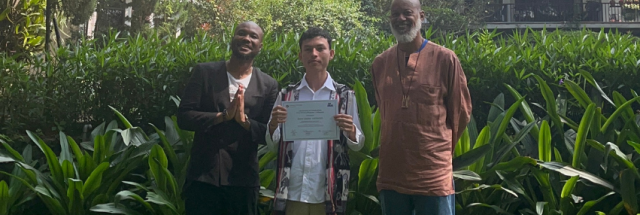
On Narratives and Dreams
By: Zaky Diory Arvindo
Editor and Proofreader : Ari Budi S
Ever since I was little, I have been a chronic dreamer, living on breaths of make-believe beyond the reach of reason. Imagining that one day I would discover I had superpowers, or that reality was just one of my dreams that had lasted a little too long, was my everyday childhood snack. As I grew up, like the other ‘grown-ups’, my dreams were replaced by brewed coffee, and make-believe slowly died, giving way to the bitterness of life. Thankfully, this afternoon on my terrace, I can still brew a cup of coffee while typing this reflection.
Dear reader, for those of us who survive by moving from one piece of bad news to the next, dreaming may well seem like a luxury. I once believed the same. Yet as life went on and I came across good times, it was the accumulation of those moments that gave birth to a new kind of awareness. Just as tiny atoms make up matter, I believe that a sliver of awareness will be born when a person, consciously or not, gathers certain moments often enough. For me, the moments that piled up over three weeks at the Caux Scholars Program were what sparked that awareness.
The three-week program at the Sandalwood Hotel in Lembang, with 22 participants from diverse backgrounds, was for me like the warmth of the eastern sun to a traveller who has been wrapped in darkness all night. From Dr David Anderson Hooker, a facilitator in the program, I learned about Narrative, a field entirely new to me that changed the way I see life.
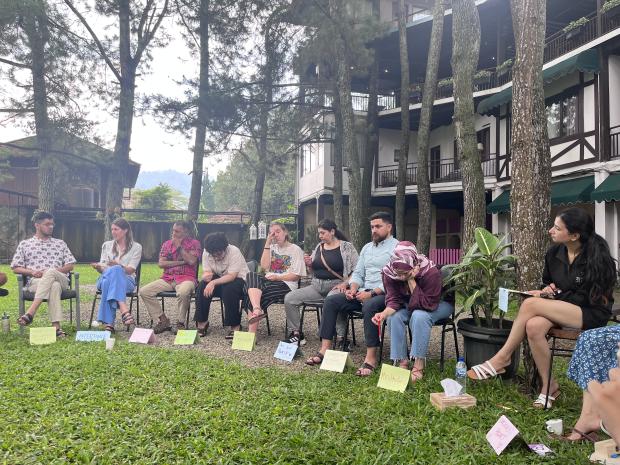
(An outdoor session with Sujatha, sharing reflections and learning beyond the classroom)
From there, I began to understand that people do not simply live in reality, but also in the stories they tell about that reality. We grow up with stories about who we are, how the world works, who deserves our trust, and what is possible or impossible to do. Some of these stories we write ourselves. Others are handed down by our families, communities, and society, until they slowly come to be accepted as normal, even as truths that no longer need to be questioned. Perhaps, without realising it, many of the decisions we consider our own free will are in fact shaped by narratives we have lived by for a long time.
From Sujatha, a facilitator who warmed my heart, I learned about Restorative Justice, a field that once again deepened my understanding of how important it is to see things as a whole, and of how much we still need traditional knowledge. There are many more remarkable people who shaped the way I see things, too many to name one by one. To all of them, including the driver who took me to the learning sites, I offer my thanks.
Perhaps, after these three weeks, I have not become a braver leader, let alone a wiser person. I have simply come home with the awareness that not every story deserves to be accepted as it is, and not every problem has to be solved in the ways I have always assumed were right. There are narratives that need to be questioned, wounds that need to heal, and old knowledge that may have been abandoned too quickly for the sake of what we call progress.
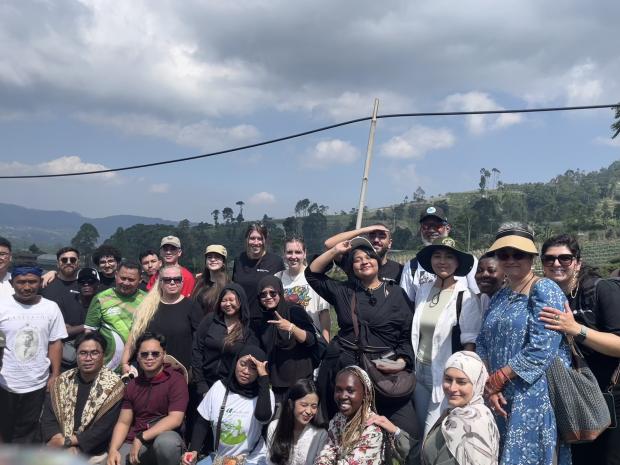
(CSP participants visited an Indigenous community)
This afternoon, with a cup of coffee on my 2 × 3 metre terrace, I am still accompanied by dreams that may be no more reasonable than before, but thankfully they now come with a slightly wider view. Finally, if it is true that people are shaped by the stories they live by, perhaps our task is not only to find good stories to believe in, but also to learn to rewrite the stories that have made us stop hoping.