
Eid Reflections: Healing Wounds, Rebuilding Connections
IofC Indonesia Weekly Update #8
Hello, this is Nenden from Indonesia. I am back again with a story from IofC Indonesia.
After a long holiday of about two to three weeks, we have returned to our usual activities. The month of Ramadan and Eid al-Fitr have passed. Have we trained ourselves to show restraint? Have we learned to surrender and protect ourselves? Have we trained ourselves to face pain and hunger? With all of that, have we become better?
It seems that 30 days will never be enough for us to practice. We must continue to practice restraint, surrender, self-protection, facing pain, and experiencing hunger throughout our lives. All of this is so we can continue to realize God's presence with full awareness.
Eid al-Fitr is an important day when we celebrate our success in fasting. However, like other holidays, Eid is also a time to return home and gather with family. That is where we return to reality. Some people feel happy, while others do not. In fact, many choose not to go home during Eid because they find it difficult to meet their family—a place that is both a source of love and a source of pain.
Many wounds are inflicted within families, and they hurt deeply because they come from those closest to us. Some people spend their entire lives trying to heal these wounds. Many experience arguments with their families during Eid, as this is when old wounds resurface and trigger strong emotions.
Pain that has been carried since childhood is often expressed when those children grow up and find their voice. Meanwhile, aging parents may begin to forget or not fully understand what is happening. Parents feel they have raised their children with love and sacrifice, while the children struggle to understand why these wounds exist and why they persist into adulthood.
Does reconciliation happen from this? Often, it does not. Arguments during Eid tend to repeat every year. Some conflicts lead to growth and resolution, but many do not end peacefully, causing similar tensions to arise again the following year.
Going home can actually become a moment for reconciliation—a time to acknowledge wounds, understand them, and forgive one another. Unfortunately, this only happens in a small number of families. In general, Eid or Lebaran in Indonesia is associated with the tradition of forgiveness. However, this meaning has begun to fade and often becomes merely ceremonial. Forgiveness becomes something easy to say, but without leading to real change.
Asking for and giving forgiveness should be an important part of Eid, alongside celebrating the completion of fasting. We become “clean” again by letting go of wounds through forgiveness, as well as by sincerely acknowledging our mistakes. This creates space for reconciliation and peace.
Hopefully, next year we can fast better and celebrate Eid more meaningfully. The hope is that more stories of change will emerge during Eid, like those shared by many School of Reconciliation students. From being afraid and reluctant to return home, many are now beginning to rebuild their relationships with their families and experience Eid more peacefully.
That is part of the story of Eid al-Fitr. Now, we have returned to our regular activities, starting with coordination meetings, life updates, and resuming our respective responsibilities.
We have also improved several leadership strategies. One of them is implementing the concept of companionship for all program coordinators and their teams. This allows challenges in the field to be identified early and addressed promptly. Guidance and coaching for coordinators have become clearer, reducing the risk of misunderstandings that may lead to conflict. As a result, we can focus more on creating impact in the community rather than dealing with internal issues.
In addition to coordination meetings, which can occur more than 10 times a week, we have taken various steps to improve our work efficiency. One of our achievements is successfully preparing financial and tax reports. Pipit, our finance coordinator, was supported technically by Noviana, a School of Reconciliation student currently living in the United States. With her assistance, IofC Indonesia successfully reported its finances to the tax authorities with a nil result, as we are a non-profit organization. This is an extraordinary achievement. Thank you, team!
For your information, during February and March 2026, we collected donations amounting to:
• IDR 7,950,643
• SGD 100
• AUD 200
• INR 100
• VND 50,000
• PHP 50
• THB 250
This level of fundraising has never happened before. We are deeply grateful to all our donors, as this support allows us to continue renting Rumah Damai for the next year. We are now preparing for another fundraising effort for the 2027 rent with a more solid strategy.
Currently, we are working on several grant proposals to support our programs. Even on the night before Eid, we were still writing proposals. The good news is that one of the grants has been approved for the Trustbuilding program. School of Reconciliation classes have also resumed, both online and in person at Rumah Damai, bringing warmth and energy back into the space.
This year marks the first anniversary of Rumah Damai. In March, we officially opened Rumah Damai as a place to grow, heal, and build trust in diversity. During this special moment, a stray kitten appeared and refused to leave. The team decided to care for it and named it BARRA, short for MEMBARA (blazing), reflecting our spirit to create change.

(Barra, a stray kitten who found a home at Rumah Damai)

(Partners of IofC Indonesia whom we invited to the Halalbihalal gathering)
We hope that this small movement can bring positive change to ourselves, our families, and our country. Even though we sometimes feel challenged by various decisions made by the government, we remain grateful that we can continue to move forward in the midst of uncertainty. At times, we may feel envious of more developed countries, but this is our country, and we share the responsibility for its future.
The change we hope for must be created by our own hands. Therefore, we need support from many people so that meaningful change can happen in Indonesia. We invite you to be part of this movement by contributing through donations, purchasing our products, visiting Rumah Damai, Feel free to contact +62 812-1352-5564 (Pipit) for donations details Any amount is welcome, or simply keeping us in your prayers.
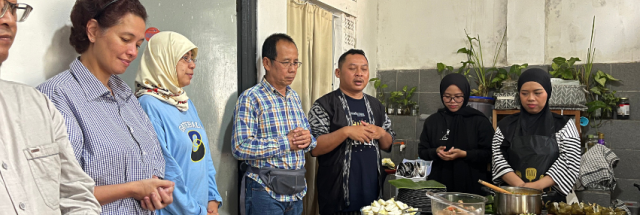
To celebrate the first anniversary of Rumah Damai, we held a Halalbihalal gathering after Eid. We prepared traditional dishes such as lontong and opor, along with Eid cookies. Interestingly, when I planned to bake a chocolate cake, several people became interested in learning as well. Perhaps cooking and baking will become part of IofC programs as a method for healing and connection.

(Making a chocolate cake while exploring the idea of a baking healing class)
That is the latest update from IofC Indonesia. If you are reading this article, please let us know by emailing us at indonesia@iofc.org
Written by Nenden Prawira
Edited and translated by Ari Budi Santosa