
WOMEN, PEACE, AND TRAUMA HEALING: WHEN STORIES AND INNER LISTENING EMPOWERED WOMEN
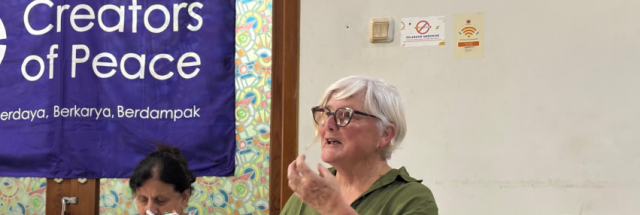
“Peace” is a word that is easy to pronounce yet difficult to do. Many peace activists share their experiences but women are still left out of the conversation. On February 12-14, 2026, an exchange program of Creators of Peace (CoP) Indonesia and Australia was held in Yogyakarta. Many women and peace activists, as well as women educators, joined the CoP Exchange residential program for 2 nights and 3 days. Judy–one of the facilitators from CoP Australia quoted Jean Brown, the president of CoP International, that women need to create peace in the family, community, and beyond. It highlights the significant role of women to create peace not only in their personal lives but also in the outside world.
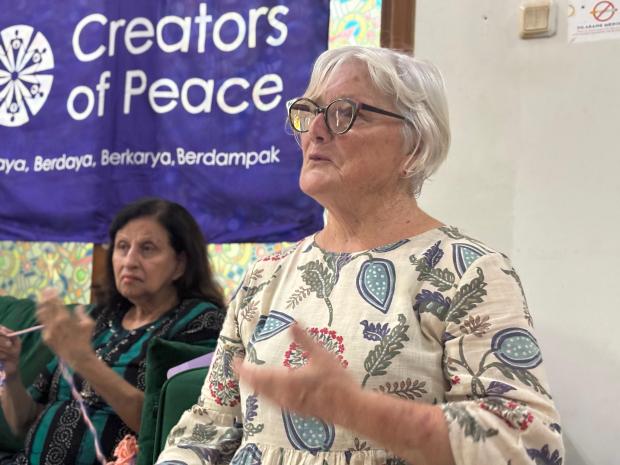
(Judy, one of the facilitators from Australia, offered her insights and reflections to the participants during the session)
Story sharing is a tradition in CoP to build inner-peace and it has led participants to be able to release their burdens. It also leads to an understanding of their feelings in certain events, conflicts, or situations. The story from Hayati, a facilitator from CoP Indonesia, about her marriage and divorce highlights that women can feel being a victim for a long time. After a long and deep reflection she found that the events also included her part in accepting the arranged marriage. She emphasized “what is your part?” during the telling of her story, while engaging the participants to remember what was their part in their own story.
Story sharing might be difficult to do as there are many stories in our life that we might not know and which one should be shared. To move from the victim state, we need inner listening to connect with ourselves. It not only helps us understand our own story, but also connects us to the past in order to help us end our story in a positive way. For instance, in the Hayati story, she needed time to do her reflection, which is inner listening. When she was in the victim state, she tended to blame everyone else, including her family, her ex-husband, and others. When she connected with herself and the inner voice she realized that she had her own part in the story and she can work on it to make a new story.
Inner listening is not merely a static state of mind, but is a practice that is preserved by Initiatives of Change around the world to connect people with themselves and the voice from a higher power. It is tied to the four absolute moral standards which are honesty, purity, unselfishness, and love and they become the filter when we are involved in inner listening, because without filters, our mind is like a chatterbox in which any thought can pop up at any time. In CoPEx Yogyakarta, inner listening was new for many participants and so they learned how this kind of listening shifts their perspective on certain conflicts they had.

(Through Inner Listening as a learning tool by IofC Indonesia, participants are guided to remain present and focused during quiet time)
Many participants found a new self during the CoPEx Yogyakarta as well as a new way to have peace within. For instance, Anis, a participant and a researcher in the National Research and Innovation Agency, found that she listened to others too much and forgot to listen to herself. She said that inner listening was a valuable session for her, showing how she could have time for herself which usually she does not have. For Cayes, a participant and Montessori teacher, the sessions with CoPEx brought her to the realization that she can transfer her wounds. She also realized that there are many untold stories in people’s lives. This realization taught her how to provide safe space and have no judgment towards others, especially her students and family. Nilna, a participant, doctor, and women’s activist, found out that she was too hard on herself and she learned that she needed to learn more about how to create inner peace so it can be manifested in her daily activities.
Significant change could be seen through how the participants reacted to emotions that came up during the program. This happened in the context of peace activists and scholars, where the field is dominated by males. Quite often, the peacebuilding field involves a lot of diplomacy and non-emotional fields. In the more complex perspective, toxic masculinity shapes our perspective on understanding feelings. It happens in many cultures where feelings and emotions are seen as weak and women are tied to this stereotype. Therefore, many women also suppress their emotions to appear as strong as men. As human beings, feelings are important because emotions give signals to us about what matters, leading to boundaries and inner-peace. When talking about safe space, it includes how we give plenty of space for emotions because stories are not just stories, but instead they carry many feelings and wounds. By giving safe space for all those feelings to come up, and sharing them through storytelling, can make the healing journey easier. As activists and peacebuilders, holding space for all those emotions is crucial to allow us to process all emotions and past events. If we can do this, the feelings will not be stuck in one emotion but instead will flow from one emotion to another, which is as it should be. Feelings are just feelings which do not justify any action such as violence.
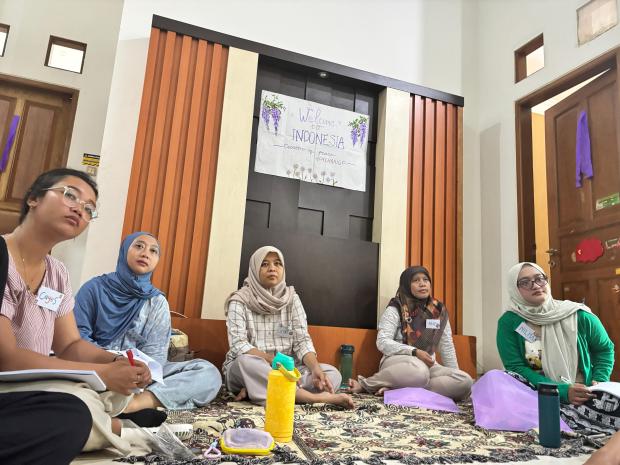
(Participants attentively listen to the facilitator’s insights, embracing listening as a skill to be continuously developed)
Endah, a participant and lecturer in Duta Wacana Christian University, and also a peace activist, mentioned that the presence of women is crucial in creating peace. She said that women gave a new perspective to the field of peace building with their informal approach and this showed the importance of women as peace builders. They have many ways to stick together to transform their stories and, when women explore their minds, bodies and feelings, they become stronger and empowered. Creating peace is not just promoting peace in the public sphere; the most important part is the peace within ourselves.
Writer : Anisa Eka Putri Kusmayani
Proof reading : Peter Heyes