
THE SIGNIFICANT TRANSFORMATION WHEN WE ACKNOWLEDGE FEELINGS DURING CONFLICT
“The framework in facing challenging conversation is like dancing”
-Mike Lowe
Over the past two decades, conflict has become increasingly visible across spheres of life, from geopolitics to daily life within families. Conflict may occur because the differences of identity, economic interest, religious beliefs, and the access to information can escalate conflict to violence. Many wars and other kinds of violence are the result of the unfinished business of small conflict and can be either confronted or ignored. Differences are an inevitable reality we should face, as well as conflict. Conflict always happens whether it’s from a discussion in Parliament to family differences, yet there are not many people who know how to deal with the people involved.
In December 2025, our Trustbuilding Program (TBP) Indonesia held a capacity building programme to equip their team and Bandung youth with the soft skills needed to face conflict. The capacity building was facilitated by Mike Lowe, the master trainer from IofC Australia. They were equipped with the module “Engaging Constructively in Challenging Conversation (ECCC)” and it emphasized the part our inner-self plays during conflict.
This opportunity provided the participants with a better understanding of the fact that every conflict comes from the individual and can escalate to the community. As Mike said, colonialism had a significant impact on how we relate to feelings because the colonial mindset prioritises the head and rational thought as a way to control outcomes. The colonial mindset distrusts feelings as weak, feminine and irrational. Therefore, even during conflict or difficult conversation, many people tend to rationalize their actions, ignoring feelings while still unconsciously being driven by them.
Through the ECCC module, participants said that it helped them to learn more about their feelings and how to reconnect to their body. There are six phases to deal with others in difficult conversations: 1. Center; 2. Choose your intention consciously; 3. Explore the others; 4. Explore yourself; 5. Express yourself; and 6. Conclude.

(Mike Lowe thoughtfully explains the main topic of the module, guiding participants through key ideas)
Pipit, one of the participants and a member of IofC’s finance team, told us that she learned how to center herself and recognize the body’s sensations during difficult conversations. Some of the participants, for the first time, learnt about the importance of understanding their feelings in conflict as they had only been exposed to academia and had learnt nothing about emotional literacy. Najwa shared her testimony that this was the first time she had to engage deeply with her feelings and how she has learnt that her emotions and feelings are a natural part of conflict. Her background is philosophy and she rarely exposed herself to feelings because her field of study encouraged her to stay in her head.
Mike also explained that feelings do not justify a certain action, such as committing violence while angry. They are different because we can still own our feelings and keep doing compassionate action. It is crucial to acknowledge our feelings before we confront a situation so we can go back to the difficult conversation in a neutral state. Alif, a Religious Studies student in the State Islamic University, as well as Riri from our IofC Indonesia’s Comms, also agreed that violence cannot be legitimised by our feelings. Riri added that when it happens, it means she is not connected to herself.
When we go deeper, we can acknowledge that our feelings matter. Iim, from the School of Reconciliation’s admin, said that she learnt how to deal with conflict and other people's feelings. She also learned how to communicate during difficult conversations. As well as Iim, Bibah, who is an alumni of the Psychology program, said that going back to herself can help to make her concerns clear and understandable by others. Difficult conversation is not only about us, but also about others. Mike said that a difficult conversation is more like dancing than marching because it doesn’t always proceed in a straight line with clear next steps. It requires two people who keep moving together–even feeling the moves of others so they know what they should do.

(Iim shared her personal discoveries during the session, as others listened carefully and wholeheartedly)
During capacity building, the participants not only learnt theories, but they also did some easy practices. They practiced role play based on emotions and some of them still had difficulties expressing their emotions, even if it was just a game. They seemed confused but slowly but surely they were able to connect with themselves and were able to recognize that they had been detached from their feelings for a long time. For the TBP team, it was a great chance to learn ECCC modules as they exposed a lot of diversity. In daily life they face people from different backgrounds and many are vulnerable so they not only hold space for others, during conflict, but also hold space for themselves.
In the future, ECCC modules might be adopted in TBP, because in terms of diversity and conflict literacy, exploring feelings is still missed in difficult situations. For humans, feelings are important, especially to recognize the imbalance or any injustice around us. Each feeling shows us meaning and concern and these feelings have a big role in our life. Because the ECCC modules came out of the IofC circle, they align with the TBP motto of “change starts with me” and acknowledges that every person has his or her own part to play during conflict.
Mike said that these are skills which should be practiced every day and so we recognise the importance that the tools from ECCC can be embodied in our daily life. By utilising these skills we can make a change in society rather than just staying in a conflict but being able to move to transformation. Even if it takes a lot of time to resolve the conflict and gain trust again, we can make a little step—which starts from ourselves.

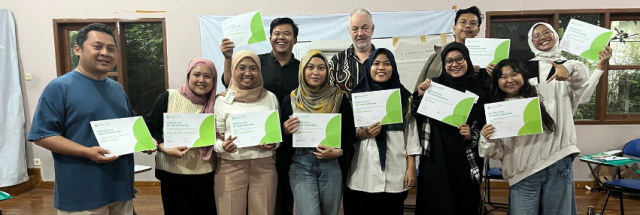
(On the final day, Mike Lowe and the participants gathered for a group photo to mark the end of the session)
Writer : Anisa Eka Putri Kusmayani
Proof reader : Peter Heyes